
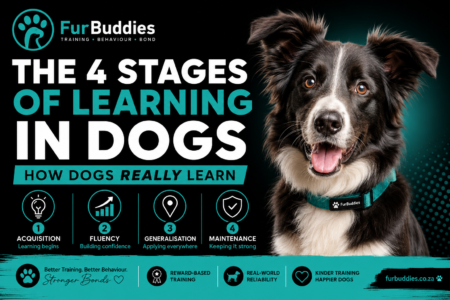
The 4 Stages of Learning in Dogs: How Puppies and Dogs Really Learn
If you’ve ever wondered why your dog listens perfectly at home but suddenly “forgets” everything at the park, you’re not alone. Understanding the stages of canine learning can completely transform the way you train your dog — and strengthen the bond you share with them.
At FurBuddies, we help dog owners across Cape Town build calm, confident, well-mannered dogs through science-based, reward-focused training. One of the biggest breakthroughs for owners is learning that dogs don’t master behaviours instantly. Training happens in stages.
In this guide, we’ll break down the four stages of learning in dogs and explain how to use them to achieve faster, more reliable results with your puppy or dog.
What Are the 4 Stages of Learning in Dogs?
Dogs learn through four progressive stages:
- Acquisition
- Fluency
- Generalisation
- Maintenance
Each stage builds on the previous one. Skipping steps is one of the biggest reasons dogs become inconsistent, distracted, or “stubborn.”
Understanding these learning stages helps owners:
- Train faster
- Reduce frustration
- Improve obedience reliability
- Build confidence in nervous dogs
- Create stronger communication
- Prevent behavioural setbacks
Professional trainers widely recognise these stages as foundational to effective dog training.
Stage 1: Acquisition — When Your Dog First Learns a Behaviour
The acquisition stage is where learning begins.
This is the first time your dog is introduced to a new cue, command, or behaviour. At this point, your dog is still figuring out:
- What you want
- How to perform the behaviour
- Which actions earn rewards
Your dog will likely make mistakes here — and that’s completely normal.
Examples of Acquisition Training
- Teaching “sit”
- Introducing recall
- Learning leash manners
- Beginning crate training
- Teaching a puppy their name
During this stage:
- Keep sessions short
- Use high-value rewards
- Be patient and consistent
- Reward even small successes
Dogs learn best through repetition and positive reinforcement. Research and training professionals consistently emphasise reward-based repetition during early learning stages.
FurBuddies Pro Tip
If your puppy only responds correctly 3 out of 10 times, they’re still in acquisition. That’s normal — keep practising without increasing difficulty too quickly.
Stage 2: Fluency — Building Reliable Responses
Once your dog understands the behaviour, you move into fluency.
Fluency means your dog can perform the behaviour:
- Faster
- More confidently
- More consistently
- With less hesitation
This is where repetition becomes critical.
Your dog is building muscle memory and clearer communication with you.
Signs Your Dog Is Becoming Fluent
- Faster response times
- Fewer mistakes
- Better focus
- Less dependence on food lures
- More enthusiasm during training
At FurBuddies, we often see owners accidentally stop rewarding too early during this stage. That can weaken the behaviour before it becomes reliable.
How to Improve Fluency
- Practise daily
- Keep commands clear
- Reward consistency
- Avoid repeating cues excessively
- End sessions positively
Fluency training helps create calm, responsive dogs that listen reliably at home.
Stage 3: Generalisation — The Most Overlooked Stage of Dog Training
This is where many owners struggle.
Dogs do not naturally generalise behaviours well. Just because your dog can “sit” in the lounge does not mean they automatically understand “sit” at the beach, vet, park, or puppy class.
To dogs, every environment feels different.
That means you must reteach behaviours in:
- Different locations
- Around distractions
- With new people
- Near other dogs
- In busy environments
Why Dogs “Forget” Commands Outside
Your dog isn’t being disobedient.
They simply haven’t fully generalised the behaviour yet.
This is why owners often say:
“My dog listens perfectly at home but nowhere else.”
That’s a generalisation issue — not stubbornness.
Training experts consistently highlight gradual exposure to new environments as essential for reliable behaviour.
How FurBuddies Builds Generalisation
At FurBuddies Puppy Training & Behaviourists, we intentionally expose dogs to:
- Real-world distractions
- Controlled socialisation
- Different surfaces and sounds
- New training environments
- Calm interactions with other dogs
This creates confident dogs that can succeed in everyday life — not just in the lounge.
Stage 4: Maintenance — Keeping Training Strong for Life
Training never truly ends.
Maintenance is the lifelong process of reinforcing behaviours so they stay reliable over time.
Without practice, behaviours weaken.
Even well-trained dogs need occasional refreshers.
Maintenance Includes
- Practising recall regularly
- Reinforcing calm leash walking
- Rewarding good choices
- Refreshing obedience skills
- Continuing mental stimulation
Think of training like going to the gym:
If you stop completely, skills fade.
The Secret to Long-Term Success
Short, regular training sessions are far more effective than occasional marathon sessions.
Even 5 minutes a day can make a huge difference.
Consistency over time creates:
- Better reliability
- Stronger focus
- Reduced behavioural problems
- Greater trust between dog and owner
Why Understanding Learning Stages Changes Everything
When owners understand how dogs learn, training becomes:
- Less frustrating
- More realistic
- More rewarding
- More successful
Instead of expecting perfection immediately, you begin working with your dog’s brain instead of against it.
That creates:
- Faster progress
- Better communication
- Reduced stress
- Happier dogs
- Happier owners
Common Dog Training Mistakes
Moving Too Fast
Owners often increase difficulty before the dog fully understands the behaviour.
Training Only at Home
Dogs need practice in multiple environments.
Repeating Commands
Saying “sit, sit, sit” teaches dogs they can ignore the first cue.
Inconsistent Rules
Mixed messages confuse dogs and slow learning.
Stopping Rewards Too Early
Rewards help maintain strong behaviours.
How FurBuddies Helps Dogs Learn Faster
At FurBuddies, our training focuses on:
- Reward-based learning
- Real-world reliability
- Puppy socialisation
- Behaviour modification
- Owner education
- Long-term success
We help dogs progress through every learning stage properly so behaviours become reliable in everyday life — not just during training sessions.
Whether you have:
- A new puppy
- A reactive dog
- A distracted adolescent
- A rescue dog
- A stubborn puller
…understanding the learning process changes everything.
Final Thoughts
Dog training is not about dominance, force, or expecting perfection overnight.
It’s about communication, consistency, and understanding how dogs actually learn.
The four stages of learning — acquisition, fluency, generalisation, and maintenance — form the foundation of successful training and long-term behavioural success.
When you respect the process, training becomes clearer, kinder, and dramatically more effective.
And that’s where truly great dogs are made
For expert assistance, reach out to us using the contact form or by clicking on the WhatsApp icon on this page. FurBuddies is here to help